

About this release
“The Loneliest Madman” is the third chapter of the conceptual album “Az Pist Ta Amma,” and the point where the album begins to shift its attention from the road outside toward the world inside the narrator.
After the movement, ambition and self-construction of the first two tracks, this song is concerned with something different: perception.
The narrator is walking through a city seemingly filled with “sane” people. Everyone is moving, chasing something and trying to make it through life. Yet the longer the narrator watches them, the less certain the meaning of sanity becomes.
Madness in this song is not presented as illness or a loss of reality. Instead, it becomes the label given to someone who still notices things that many others have stopped seeing: flowers, water, moonlight, the flight of a bird, the laughter of a child, or a tree forcing its way through metal bars simply to keep growing.
Against that perspective stands a city that considers itself rational.
People are constantly struggling toward tomorrow, sometimes becoming so consumed by the effort to arrive that they forget to experience the present. Behind some of that struggle, the narrator sees performance, imitation and dishonesty.
That creates one of the song's central questions:
If sanity means losing the ability to notice what makes life feel alive, then perhaps being called crazy is not much of an insult.
A child becomes one of the most important images in the story.
When the child sees the narrator jumping with excitement, the immediate reaction is laughter. There is no need to explain the behavior or place it into a category. Someone nearby, however, quickly provides an explanation: this person must simply be crazy.
In that brief exchange, two ways of seeing the world collide — one that observes before judging, and another that feels the need to define anything unfamiliar.
Farther along the road, the narrator discovers a tree twisted through metal bars.
It grew somewhere that was never designed for growth. Unable to take a straight path upward, it bent, turned and forced itself through whatever space remained.
Its shape is not evidence of failure.
It is evidence of survival.
The tree carries the history of every obstacle in its body, yet it continues upward. The very forces that distorted its shape have become part of what makes it beautiful.
Then a bird leaves the tree.
The narrator's eyes follow it through the sky, becoming so absorbed in its movement that there is an accidental collision with another person.
The expected response might be anger, blame or confrontation.
Instead, the stranger helps the narrator back up, apologizes and explains that they had been distracted by the birds as well.
That moment changes the entire song.
For the first time, the narrator encounters someone who appears to see the world in a similar way — someone capable of becoming so absorbed in the flight of a bird that the movement of the city briefly disappears.
A thought immediately follows:
This person is supposed to be sane.
What if they're crazy too?
And gradually, the answer becomes clear.
Maybe there are more “mad ones” than the narrator ever realized.
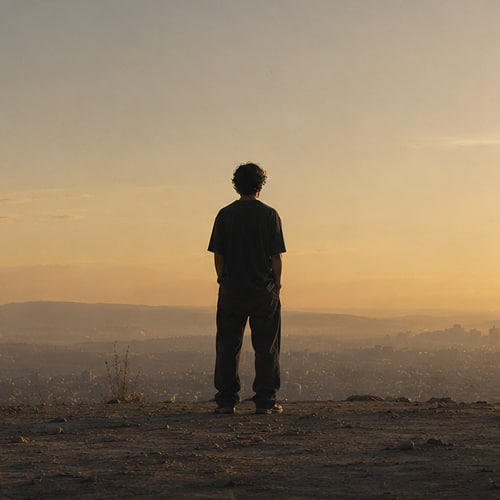
At the beginning of the song, loneliness is part of the narrator's identity. They talk to themselves, move alone and observe the city from a distance.
By the final chorus, however, the most important transformation takes place.
“I” becomes “we.”
The loneliest mad one is no longer alone.
The reaction of the surrounding crowd provides the story's final irony. When the narrator finally speaks, everyone is surprised, as though silence had automatically meant inability.
The stranger understands immediately.
The narrator could always speak.
They simply chose not to.
That single observation completes one of the central ideas of the song: much of what people believe they know about others may be nothing more than assumptions made from a distance.
“The Loneliest Madman” is ultimately not about finding someone exactly like yourself.
It is about realizing that among all the people who seem to have accepted the same rules of living, there may still be others who stop, notice, wonder, watch the birds and refuse to sacrifice every moment of today for a tomorrow that has not arrived yet.
By the end of the track, the city remains the same.
The passersby remain the same.
The rules of the world have not changed.
Only one thing has.
The loneliest mad one is no longer alone.
Lyrics
Keep listening






Comments
6 comments